
You know how many Microsoft licenses your company pays for. Can you explain why each group of employees has the licenses it does?
Not which plan was easiest to order. Not what the previous provider recommended three years ago. Why that combination fits the work, devices, and protection requirements of the people using it today.
A license report shows what you bought. It does not establish that you bought the right operating model.
Headcount is a purchasing input. It is not a licensing strategy
Assigning the same plan to everyone makes administration look simple. It can also hide very different requirements behind one subscription name.
A field employee using shared devices, a finance analyst working with sensitive documents, and an IT administrator performing privileged tasks should not be assumed to have identical needs.
That does not automatically mean they need different subscriptions. It means the recommendation should follow an assessment of their work rather than the convenience of a uniform order.
Microsoft 365 license optimization is the process of aligning entitlements, actual requirements, security coverage, and commercial commitments. Removing unused seats is one part of that process, not the entire strategy.
The most expensive mistake is not always the most expensive plan
An oversized plan can waste money. An undersized plan can remove capabilities the company relies on. The objective is therefore not to find the lowest subscription price. It is to establish the least costly appropriate combination that supports the intended service and protection model.
Consider an illustrative finance employee who mainly uses email and spreadsheets. A simple application usage report may suggest that a lower tier is enough.
But that report does not, by itself, answer whether the employee needs managed devices, particular identity controls, or information protection capabilities. Those requirements must be evaluated separately, along with the licensing terms that apply.
“Mostly uses Outlook” is a useful observation. It is not a complete downgrade recommendation.
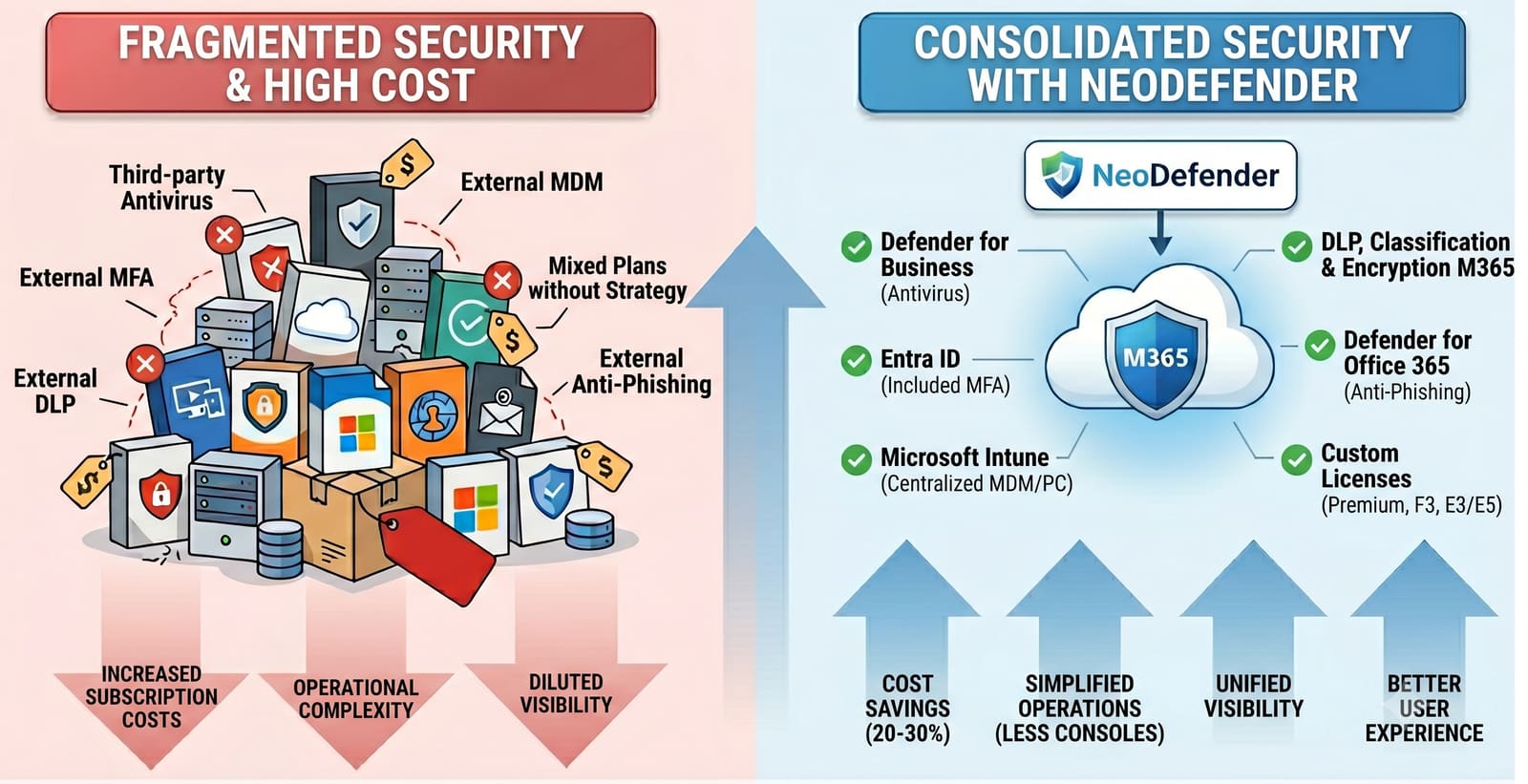
This is why NeoDefender’s Licensing Optimization service starts with usage, role profiles, device requirements, and security, not a blanket instruction to buy a cheaper plan.
Security value does not always appear as application activity
Users generate visible activity when they open applications, send messages, or work on documents. Security and management capabilities do not necessarily appear in those reports as applications the employee launches.
Low activity in a productivity service is therefore different from proof that the employee does not require a protective control.
Before changing a license, identify the capabilities the current design depends on and confirm the rights required for the users or devices in scope. Do not assume that a tenant-wide configuration makes licensing requirements irrelevant.
The reverse assumption is also unhelpful: purchasing a higher tier does not prove its capabilities are configured or delivering the intended outcome.
Licensing and implementation are connected decisions. Neither substitutes for the other.
Build profiles around work, not job titles alone
A useful licensing profile describes the working environment and required outcomes.
Does the employee need installed desktop applications or supported browser-based workflows? Which devices do they use? Which information do they handle? What access and protection requirements apply? Are specialist services or add-ons necessary?
Job titles can help organize the review, but they should not replace it. Two people in the same department may have different device needs or business responsibilities.
Keep the number of profiles manageable. A separate design for every employee creates administrative complexity that can outweigh the benefit. The goal is a small set of explainable profiles with controlled exceptions.
Each profile should have a rationale, an owner, and a process for handling changes.
A license change is not automatically a saving
There is also a difference between changing an assignment and reducing the amount the company pays.
An unassigned seat may remain a purchased subscription. The ability to reduce a quantity, cancel a subscription, or change a commercial commitment depends on the agreement, purchase channel, applicable terms, and timing.
Monthly billing should not be assumed to mean a monthly commitment. Confirm the actual subscription terms before promising an immediate reduction.
A credible business case separates changes that can produce savings now from those that depend on a renewal or another permitted adjustment window. It also accounts for replacement subscriptions or add-ons needed to preserve the intended capabilities.
The relevant figure is the achievable net change, not the price difference between two plan names.
Validate before changing the population
For a proposed profile change, confirm the current requirements and the destination entitlements. Identify any prerequisites, data-handling considerations, and service dependencies affected by the change.
Then use a controlled pilot where appropriate. Test representative tasks and verify that required security and management capabilities remain supported by the resulting licensing model.
Communicate the change, define acceptance criteria, and establish a way to correct a poor fit. A licensing spreadsheet should not become a production change without operational validation.
This is where managed Microsoft security and licensing advice need to work together: the financial recommendation must preserve the protection architecture the business intends to operate.
Make the renewal a decision, not a repetition
People change roles. Devices change. New applications and business requirements appear.
A licensing model that once made sense can become a historical artifact if nobody revisits its assumptions.
Maintain a review backlog with the proposed action, supporting evidence, expected impact, accountable owner, and commercial timing. Reassess exceptions and feed the results into renewal planning before the decision window closes.
At NeoDefender, the objective is not to sell everyone the same plan, or move everyone down a tier. It is to make the licensing model explainable, supportable, and aligned with how the business actually works.
You should be able to defend more than the number of seats on the invoice. You should be able to explain the design behind them.
Talk to NeoDefender about your Microsoft 365 licensing. Let’s review your working profiles, security requirements, and subscription commitments before your next renewal repeats decisions that no longer fit.